Customer Portal
A secure self-service portal where business customers follow orders and projects, pay invoices, download documents and open support tickets — with a staff side for the team behind it.
Project facts
- Project type
- Customer portal
- Category
- Business systems
- Industry
- B2B services & suppliers
- Technology stack
- Next.js
- React
- TypeScript
- PostgreSQL
- Prisma
- WebSockets
- S3-compatible storage

Overview
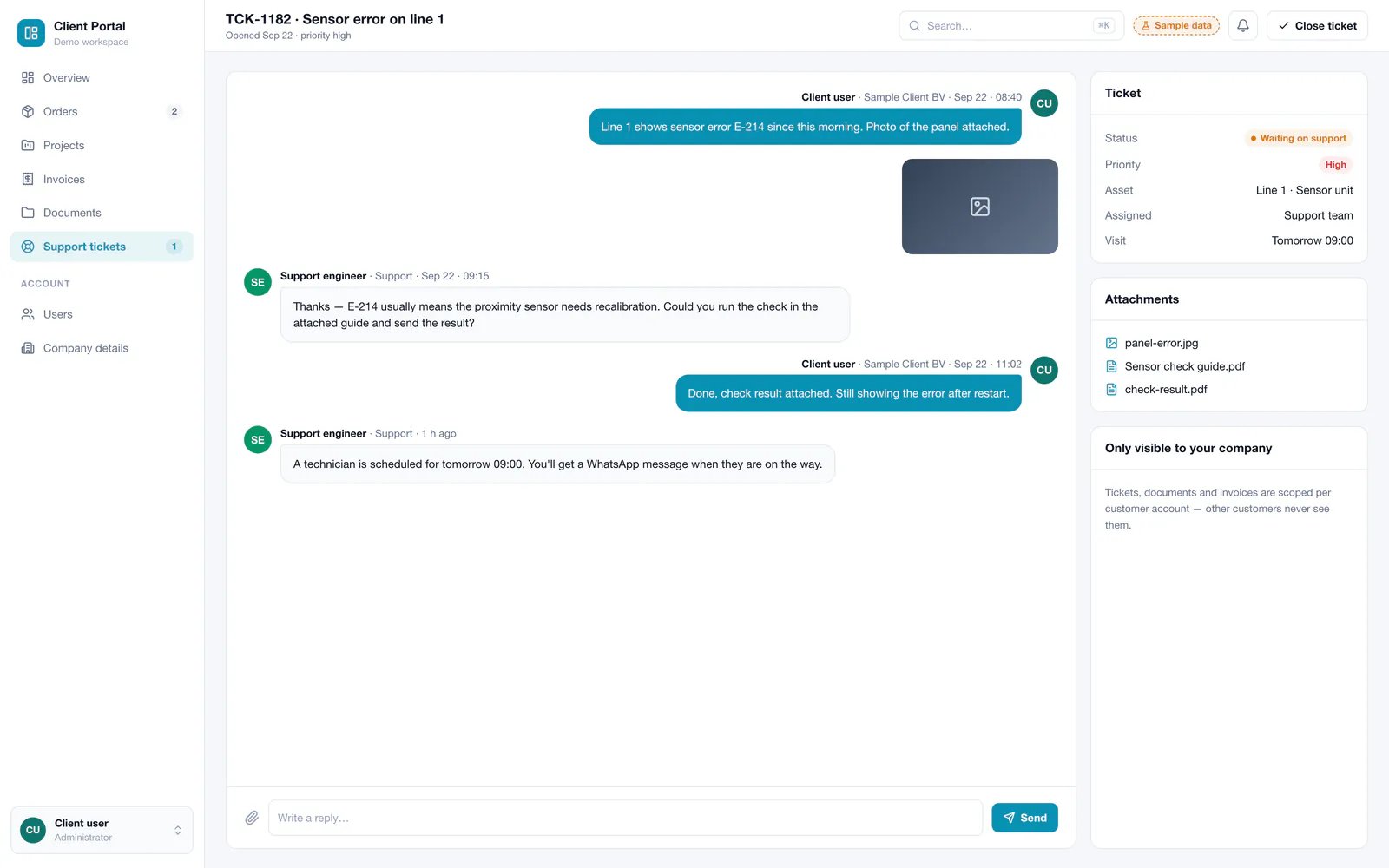
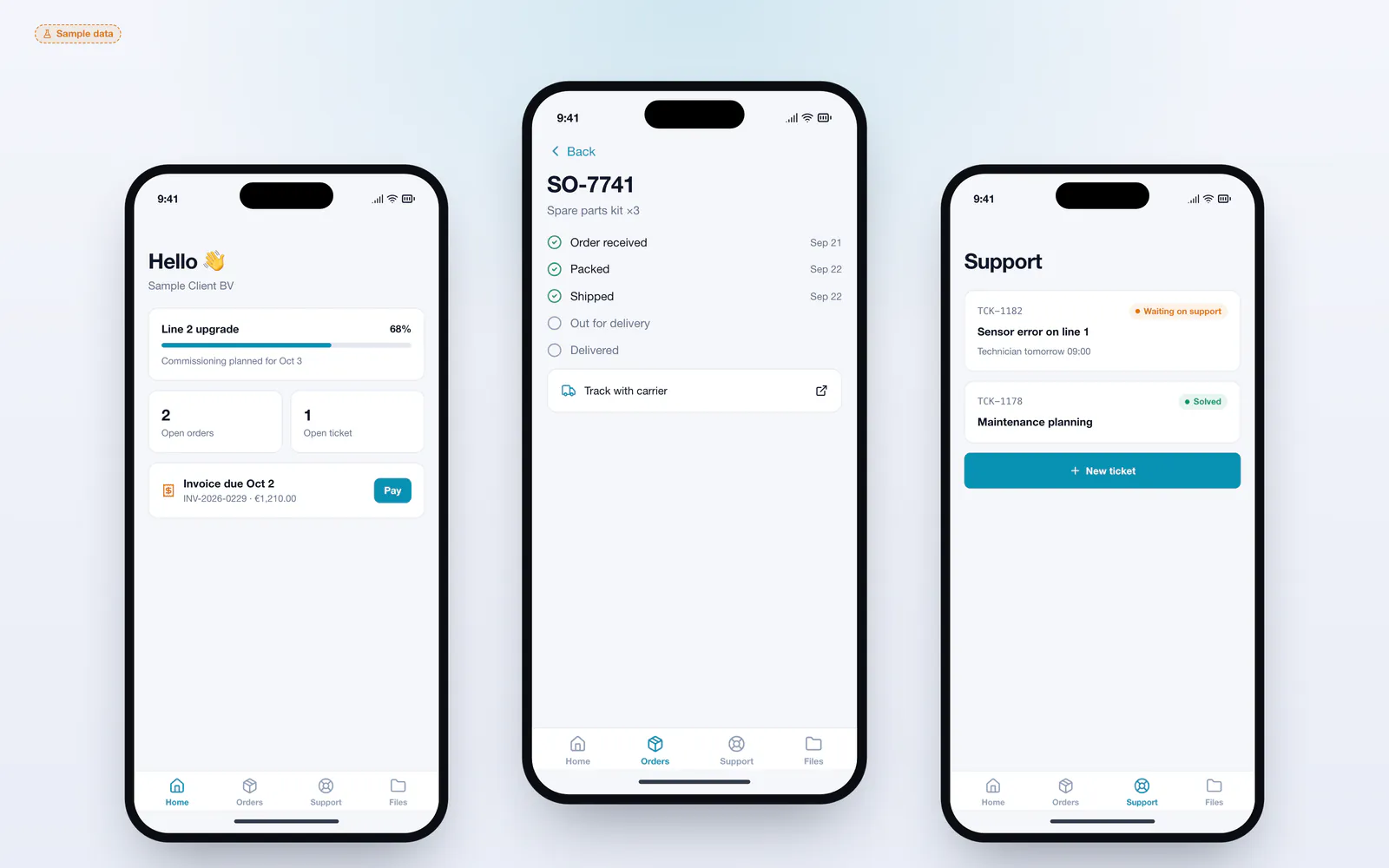
This demonstration project shows a customer portal for a B2B supplier of equipment and services. Each customer company gets its own secure area with several users: open orders with delivery tracking, a project timeline, invoices they can pay online, shared documents and a support channel with ticket history.
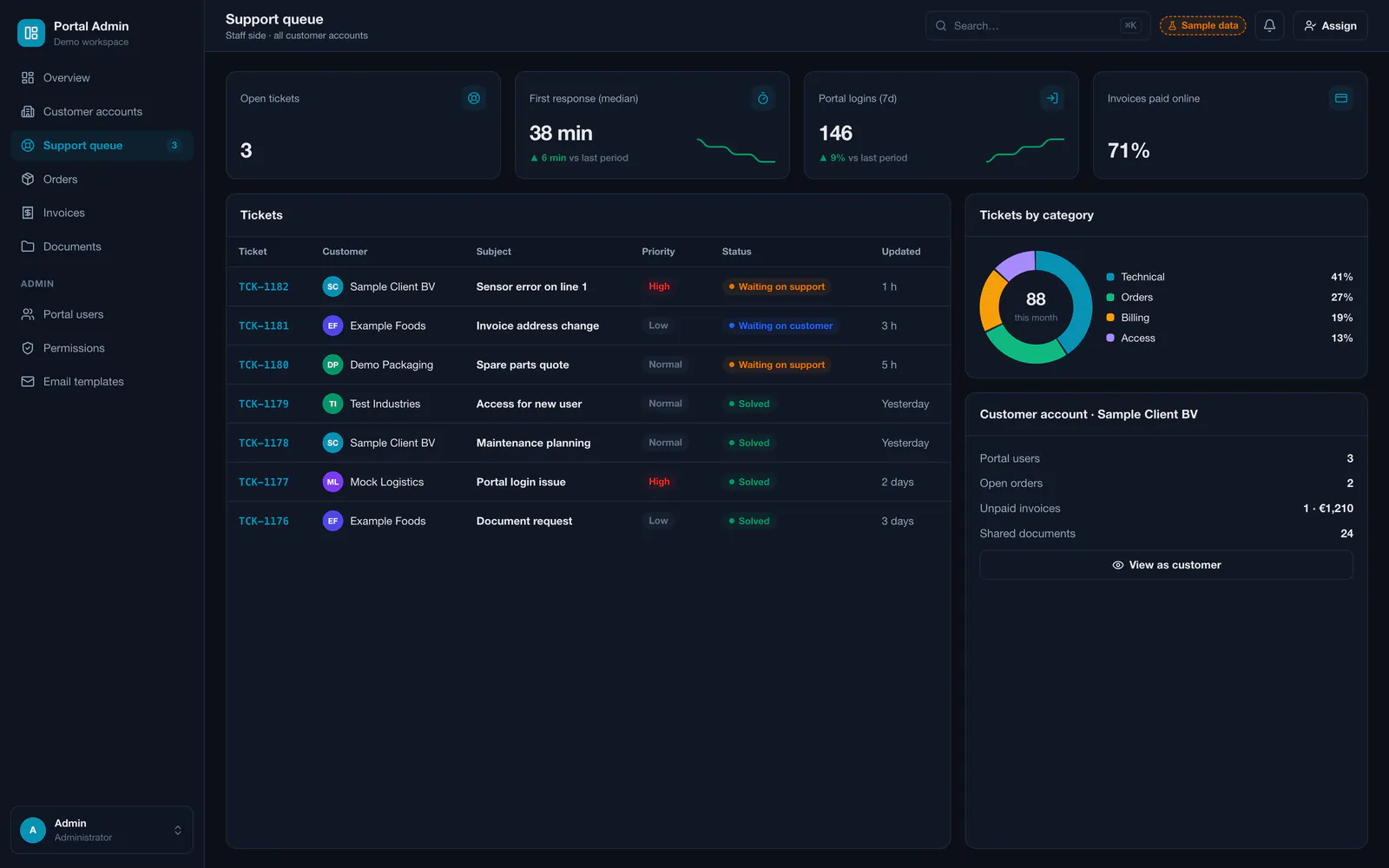
On the staff side, the team sees every customer account, works a shared support queue and can view the portal exactly as a customer sees it. The same pattern suits agencies, installers, logistics providers and software vendors.
The challenge
Without a portal, customers ask the same questions by phone and email: where is my order, can you resend that invoice, what is the status of the project, who handles my issue? Answers depend on who picks up, documents are lost in inboxes, and staff spend hours on requests the customer could handle themselves. Sharing documents by email also makes access hard to control.
The solution
The concept gives customers one place for everything that concerns their account. Orders show live status and tracking, projects show phases and updates, invoices can be paid online, and documents are shared per account with access controlled by role. Support runs through tickets with attachments and a clear status, so both sides see the full history. Staff work from a queue with priorities and can assign, answer and close tickets.
Key features
- Customer accounts with multiple users and roles
- Order status and delivery tracking
- Project timeline with phases and published updates
- Invoices with online payment and PDF download
- Document sharing per account with controlled access
- Support tickets with attachments, priority and status
- Staff queue with assignment and response times
- “View as customer” for support staff
Who it is for
- B2B suppliers and service companies with recurring customers
- Installers and agencies running projects for clients
- Teams answering the same status questions every day
- Companies that share contracts and reports by email today
Technical approach
One Next.js application serves the customer portal and the staff side, with every query scoped to the customer account and role on the server. PostgreSQL via Prisma stores accounts, users, orders, projects, invoices, documents and tickets. Files are stored in S3-compatible storage and served through short-lived signed links, ticket updates arrive live over WebSockets, and single sign-on can be offered to larger customers through OpenID Connect.
- Frontend
- Backend
- Database
- Infrastructure
- Integrations
- MollieOpenID ConnectSMTP
Screens
Customer-facing interface
Admin interface
Mobile & responsive views
Services behind this project
The work in this case study maps onto these services. Each page explains scope, process and what you receive.
Related projects
All projects SaaS platformsSaaS platform
SaaS Management Platform
A multi-tenant SaaS foundation with workspaces, members and roles, subscription billing, usage limits, an audit log and an operator console for the team that runs the product.
- Next.js
- React
- TypeScript
- PostgreSQL
- Prisma
- +4
 Business systemsCRM system
Custom CRM System
A CRM shaped around one sales process: lead capture from the website and WhatsApp, a visual pipeline, contact timelines, follow-up tasks, quotes and a sales dashboard.
- Next.js
- React
- TypeScript
- PostgreSQL
- Prisma
- +2
 Business systemsBooking system
Booking & Reservation Platform
An online booking system with live availability, staff calendars, deposits, automatic reminders by email and WhatsApp, and an admin view for bookings, no-shows and capacity.
- Next.js
- React
- TypeScript
- PostgreSQL
- Prisma
- +3
Questions about this type of project
Is this portal in use by a real company?
No. It is a demonstration project with sample customer accounts, orders and tickets. It shows how Saad builds a secure customer portal.
How is one customer prevented from seeing another customer's data?
Every record belongs to a customer account, and the server checks the signed-in user's account and role on every request. Files are delivered through short-lived signed links, so a copied link stops working.
Can the portal connect to our existing systems?
Usually yes. Orders, invoices or project data can be read from an existing ERP, CRM or accounting system through its API, so the portal shows the same information your team works with.
Want a similar project?
Tell Saad what you need. You get a clear scope, a phased plan and direct contact with the developer who builds it — no middlemen.
Direct, clear communication
You talk directly to the engineer writing the code — no sales intermediaries, no vague delivery dates.
Fully custom solutions
No ready-made WordPress themes or copied code — every line is written to fit your business's exact requirements and scale.
From idea to launch
Help shaping the specification and turning a rough concept into a real, usable digital product.
The request form opens with this type of project already selected.